
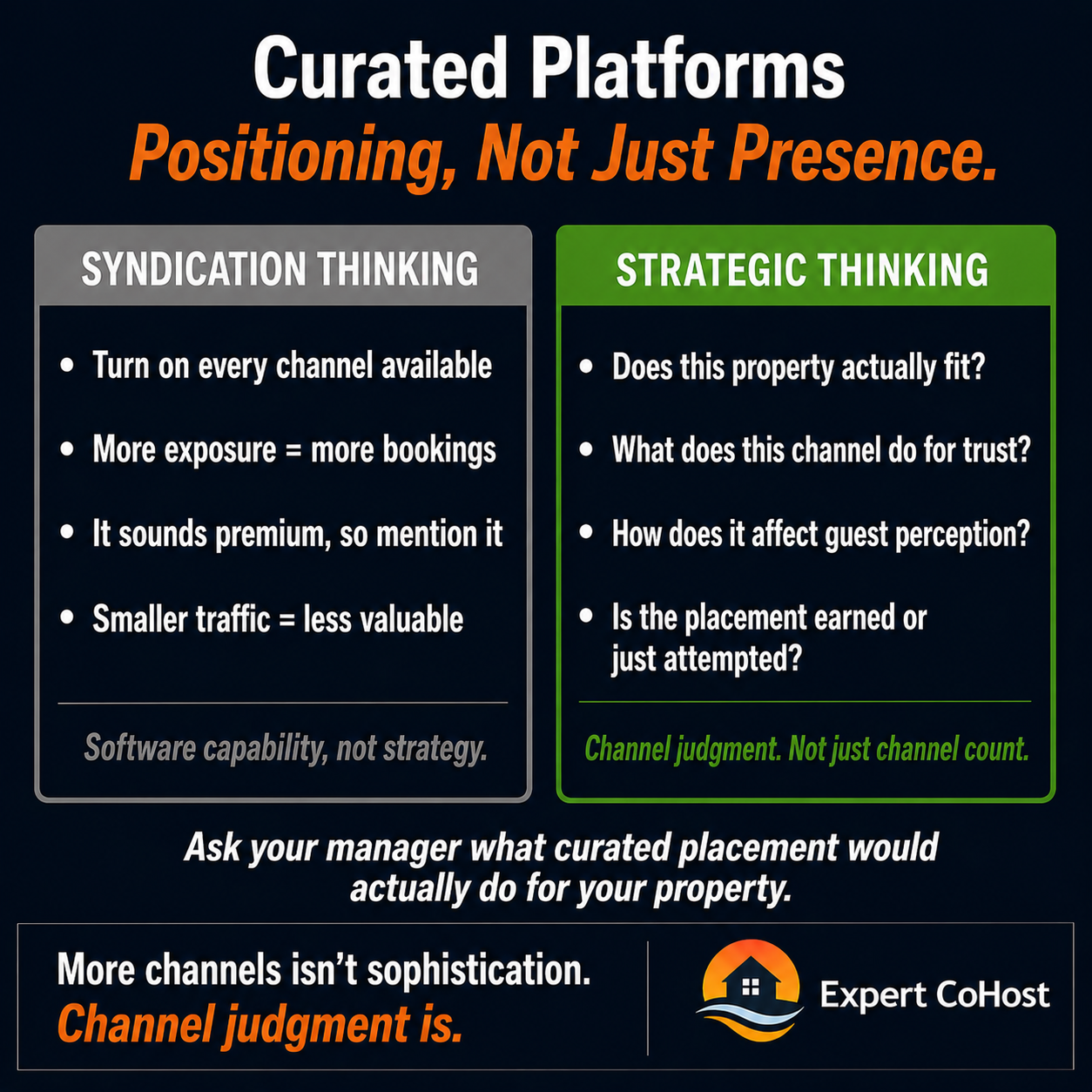
A lot of property managers do not know how to think about curated listing platforms.
Some dismiss them immediately.
Some mention them only to sound sophisticated.
Some reduce them to “luxury channels.”
Some treat them like smaller, less important versions of Airbnb or Vrbo.
Some never develop a real opinion at all.
That should get an owner’s attention.
Because when a property manager cannot clearly explain the purpose of a curated channel, it usually reveals something bigger: they may not understand distribution strategy beyond the obvious mass-market platforms.
And that matters.
Because curated listing platforms are not trying to do the same job as broad marketplaces. They are not primarily about maximum inventory volume. They are not built around casting the widest net possible. They are not simply backup channels for nights that did not book elsewhere.
They serve a different function.
And the managers who understand that tend to make better decisions than the ones who only think in terms of raw exposure.
Curated Platforms Are Not Just Smaller Marketplaces
This is the first thing owners need to understand.
A curated platform is not just a marketplace with fewer listings.
It is a different type of channel.
That difference is strategic.
Broad booking platforms are usually built around scale. They want a large amount of inventory, broad consumer traffic, and a booking experience designed to support as many properties and trip types as possible.
Curated platforms work differently.
They are usually built around selectivity, positioning, standards, and guest confidence within a narrower band of homes. That means the channel is not trying to be everything to everyone. It is trying to create a more filtered environment.
That matters because filtered environments create different expectations.
And different expectations change how a property is perceived.
A lot of property managers miss that entirely.
They assume a platform is mainly valuable based on how much traffic it has or how many bookings it can theoretically produce. That is far too simplistic.
Some channels are valuable not because they are broad, but because they are selective.
What Curated Platforms Are Best For
Curated listing platforms are best for positioning.
That is their clearest strategic role.
They can help a property appear in a more selective context. They can reinforce quality. They can support a more premium first impression. They can sometimes place a home in front of travelers who are not just looking for availability, but for a more filtered level of confidence.
That is not the same thing as raw scale.
And it is not supposed to be.
For the right home, curated placement can do several useful things:
-
strengthen perceived quality
-
reduce some of the noise that comes with mass-market competition
-
place the home in a more selective booking environment
-
reinforce the idea that the property meets a higher standard
-
align the stay with a more intentional presentation strategy
That does not mean every home belongs there.
It means the channel can be strategically useful when the property, brand, and operational quality support it.
That is a very different idea from simply “listing in more places.”
What Most Property Managers Miss
This is where the gap usually becomes obvious.
A lot of property managers only know how to evaluate channels in terms of volume.
How many eyeballs?
How many bookings?
How much reach?
How much exposure?
Those are not bad questions.
They are just incomplete.
Because a curated channel is not always most valuable for raw volume. Sometimes its value comes from what it says about the property, the type of guest it may appeal to, and the context in which the home is being discovered.
That is a more nuanced kind of value.
Weak managers often miss it because they are too focused on syndication logic.
If it is a channel, turn it on.
If it gets traffic, use it.
If it does not produce enough volume, dismiss it.
That is not very sophisticated.
A stronger manager asks better questions:
What kind of environment does this channel create?
What kind of property actually belongs there?
What kind of guest confidence does it support?
How does it affect the overall brand positioning of the home?
What role does it play in the broader mix?
That is real strategy.
Curated Platforms Are About Fit, Not Just Prestige
This is important.
Some managers hear the words “curated” or “premium” and immediately jump into prestige language.
They want owners to feel impressed.
They talk about exclusivity.
They talk about luxury.
They talk about high-end exposure.
They talk about premium travelers.
Sometimes that language is empty.
Because the real issue is not whether a channel sounds impressive.
The real issue is whether it fits.
Does the home actually belong in that environment?
Does the guest experience support the level of confidence the channel implies?
Is the property being managed at a level that makes the placement meaningful?
Does the channel strengthen the property’s position in a useful way?
That is what matters.
A curated platform that fits poorly is not strategic just because it sounds upscale.
And a property manager who cannot tell the difference is not thinking at a very high level.
This Is One of the Clearest Tests of Management Judgment
Curated platforms are useful because they reveal how a manager thinks.
A shallow manager often thinks like this:
If it gets bookings, good.
If it is smaller, probably less important.
If it sounds fancy, mention it in the sales pitch.
If it does not produce obvious volume right away, move on.
A stronger manager thinks differently.
They understand that not every channel exists to produce the same kind of outcome. Some channels help with discovery. Some with conversion. Some with loyalty. Some with direct demand. Some with seasonal stability. And some with positioning.
Curated platforms sit heavily in that positioning category.
That is why they are such a useful test.
If a manager cannot explain how positioning affects performance, then they probably do not understand the full landscape very well.
Not Every Home Should Be on a Curated Platform
This is one of the most important things owners should hear clearly.
Not every property belongs on a curated listing platform.
And that is fine.
That is not a weakness of the channel. It is part of the point.
Curated platforms only make sense when the home, the presentation, and the guest experience support that placement. If the home does not fit, then forcing it into that environment is not strategy. It is ego.
This is where weak property managers often make one of two mistakes.
They either dismiss curated platforms because not every home qualifies.
Or they overuse prestige language and imply that every owner should want to be there.
Both responses miss the point.
The smarter position is much simpler:
Some homes belong in more selective environments.
Some do not.
A good manager should know the difference.
That is what owners should be paying for.
Curated Placement Can Influence Perception Beyond the Channel Itself
This is another reason these platforms matter.
Even when they are not the largest source of bookings, curated channels can shape how a property is perceived more broadly.
They can reinforce quality.
They can support the credibility of the brand behind the property.
They can contribute to a stronger overall positioning story.
They can help the home feel less like one more listing in a sea of inventory.
That is not a trivial benefit.
A lot of managers underestimate the value of perception because it is harder to measure than raw booking count.
But perception affects trust.
Trust affects conversion.
Conversion affects performance.
That is why curated channels should not be evaluated only by the most obvious numbers.
Their value may be partly reputational, contextual, and strategic.
A manager who cannot think that way is probably too mechanical in how they approach distribution.
Where Owners Get Misled
Owners often assume that if a property manager mentions curated platforms, that means the manager understands them.
Not necessarily.
Sometimes the manager is simply using prestige language because it sounds impressive. Sometimes they are name-dropping channels without having a real framework for when those platforms add value. Sometimes they are trying to create the appearance of sophistication without actually offering much judgment.
This is why owners should ask sharper questions.
Not:
Do you use premium channels?
But:
Why would my property belong there?
What would that placement actually do for me?
How would it fit into the larger strategy?
What kind of guest environment would it create?
What standards would the property need to meet?
How do you know whether the fit is real?
Those are much better questions.
And they are often uncomfortable for weak managers, because they force them to explain rather than impress.
What Owners Should Ask Their Property Manager About Curated Platforms
Owners do not need to become experts in every platform.
But they should ask thoughtful questions.
For example:
Is my property actually a fit for a curated listing platform?
If so, why?
If not, why not?
What would curated placement contribute that broader channels do not?
Would it help with positioning, guest trust, or a particular type of demand?
Is this about real fit or just premium-sounding marketing language?
How would curated placement connect to the broader distribution strategy?
What standards would need to be maintained to justify being there?
Those questions matter because they reveal whether the manager has real judgment or just generalized enthusiasm.
A strong manager can answer clearly.
A weak one usually cannot.
The Bigger Point
Plum Guide and other curated listing platforms matter for a reason that goes beyond any single brand.
They reveal whether a property manager understands that distribution is not only about volume.
Some channels are built for maximum exposure.
Some are built for flexibility.
Some are built for brand trust.
Some are built for loyalty.
And some are built for selective positioning.
That is the bigger lesson.
Owners should not only ask where their property is listed.
They should ask what each channel is supposed to do.
That is the difference between syndication and strategy.
And a lot of property managers are still operating much closer to syndication than strategy.
Final Thought
Curated listing platforms should not be treated like smaller versions of Airbnb or Vrbo.
They are not trying to do the same job.
They are selective channels that can serve an important role in positioning, trust, and presentation when the property genuinely fits the environment.
The best property managers understand that.
They do not dismiss curated platforms just because they are narrower.
They do not overhype them just because they sound premium.
They do not force every home into the same model.
They understand what each channel is actually for, which homes belong where, and how to build a distribution strategy that reflects judgment rather than just software capability.
That is what owners should be paying for.
Not just more channels.
Better channel thinking.