
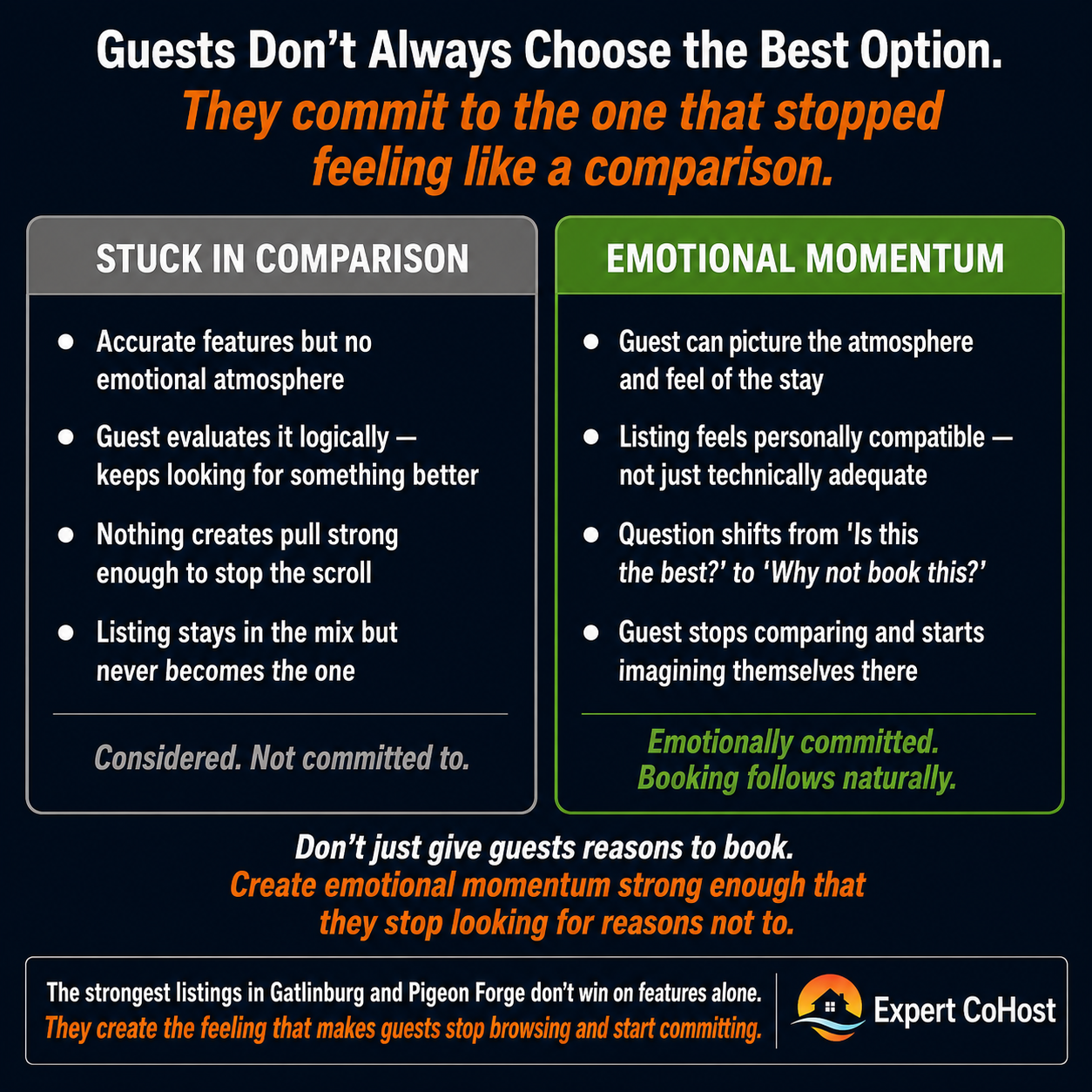
Most Airbnb guests believe they’re making rational booking decisions.
They compare:
- prices
- amenities
- reviews
- locations
and assume they’re choosing the objectively best option.
But many booking decisions happen much faster — and far more emotionally — than guests realize.
Sometimes, a guest opens a listing and almost immediately feels:
“This is the one.”
That emotional commitment often happens before the logical comparison process fully finishes.
Guests Rarely Browse Without Emotion
Booking a short-term rental is not purely transactional.
Guests are often planning:
- vacations
- reunions
- celebrations
- escapes from routine
- emotionally meaningful experiences
Which means emotion enters the decision-making process very early.
Guests are not only searching for accommodations.
They’re searching for a feeling.
Emotional Commitment Happens Before Full Analysis
Interestingly, many guests emotionally commit to a listing before consciously deciding to book it.
The listing creates an immediate sense of:
- comfort
- excitement
- trust
- emotional fit
- anticipation
Once that emotional momentum begins, the guest often starts evaluating the listing differently.
Instead of asking:
“Is this the absolute best option?”
they begin asking:
“Is there any reason not to book this?”
That psychological shift is extremely powerful.
Certain Listings Create Immediate Emotional Alignment
Some listings instantly feel emotionally aligned with what the guest wants the trip to become.
Guests can picture:
- the atmosphere
- the routines
- the emotional tone of the stay
- how the experience may feel during the trip
That emotional clarity reduces hesitation quickly.
Because uncertainty decreases once the guest feels emotionally connected to the experience being imagined.
Guests Want the Decision to Feel Easy
One of the strongest hidden drivers of emotional commitment is ease.
Guests feel drawn toward listings that make the booking decision feel emotionally simple.
Not because they stopped caring about details.
But because the listing already feels:
- trustworthy
- emotionally compatible
- easy to imagine
- low-risk psychologically
The brain naturally prefers decisions that feel emotionally resolved.
Emotional Resonance Interrupts Comparison Browsing
Many guests begin browsing in “comparison mode.”
They rapidly evaluate multiple options without strong attachment.
But emotionally resonant listings interrupt that pattern.
The guest slows down.
They spend more time on the photos.
They start imagining themselves inside the stay.
The listing stops feeling like one option among many.
And starts feeling personal.
Strong Listings Reduce Internal Conflict
Booking hesitation usually comes from unresolved emotional uncertainty.
Questions like:
- “Will this feel worth it?”
- “Will the stay disappoint me?”
- “Am I making the right choice?”
create psychological friction.
But certain listings reduce that friction quickly through:
- emotional clarity
- strong atmosphere
- consistent presentation
- trust-building signals
- clear positioning
The experience feels emotionally coherent.
And coherence creates confidence.
Guests Emotionally Invest Before They Pay
One reason emotional commitment matters so much is because guests often become psychologically invested before booking even happens.
They begin imagining:
- moments during the trip
- conversations in the space
- how they’ll feel waking up there
- the emotional tone of the experience
That imagination creates attachment.
And attachment increases booking momentum dramatically.
Listings That Lack Emotional Pull Feel Easier to Leave
Some listings may technically offer:
- better pricing
- more amenities
- stronger specifications
Yet still struggle to create emotional momentum.
Because the experience never feels emotionally alive.
Guests continue browsing because no emotional commitment forms.
Without emotional attachment, comparison shopping continues indefinitely.
Emotional Certainty Feels Like Confidence
Guests often describe emotionally compelling listings as:
- “feeling right”
- “standing out”
- “just feeling different”
But underneath that reaction is usually emotional certainty.
The guest no longer feels like they’re evaluating random accommodations.
They feel like they’ve found an experience that emotionally fits what they want the trip to become.
The Real Shift
Most hosts focus heavily on helping guests logically justify the booking.
But many decisions happen earlier — and emotionally deeper — than that.
Because the strongest Airbnb listings do more than communicate features.
They create emotional momentum strong enough that guests stop browsing like evaluators…
…and start imagining themselves already inside the stay.