
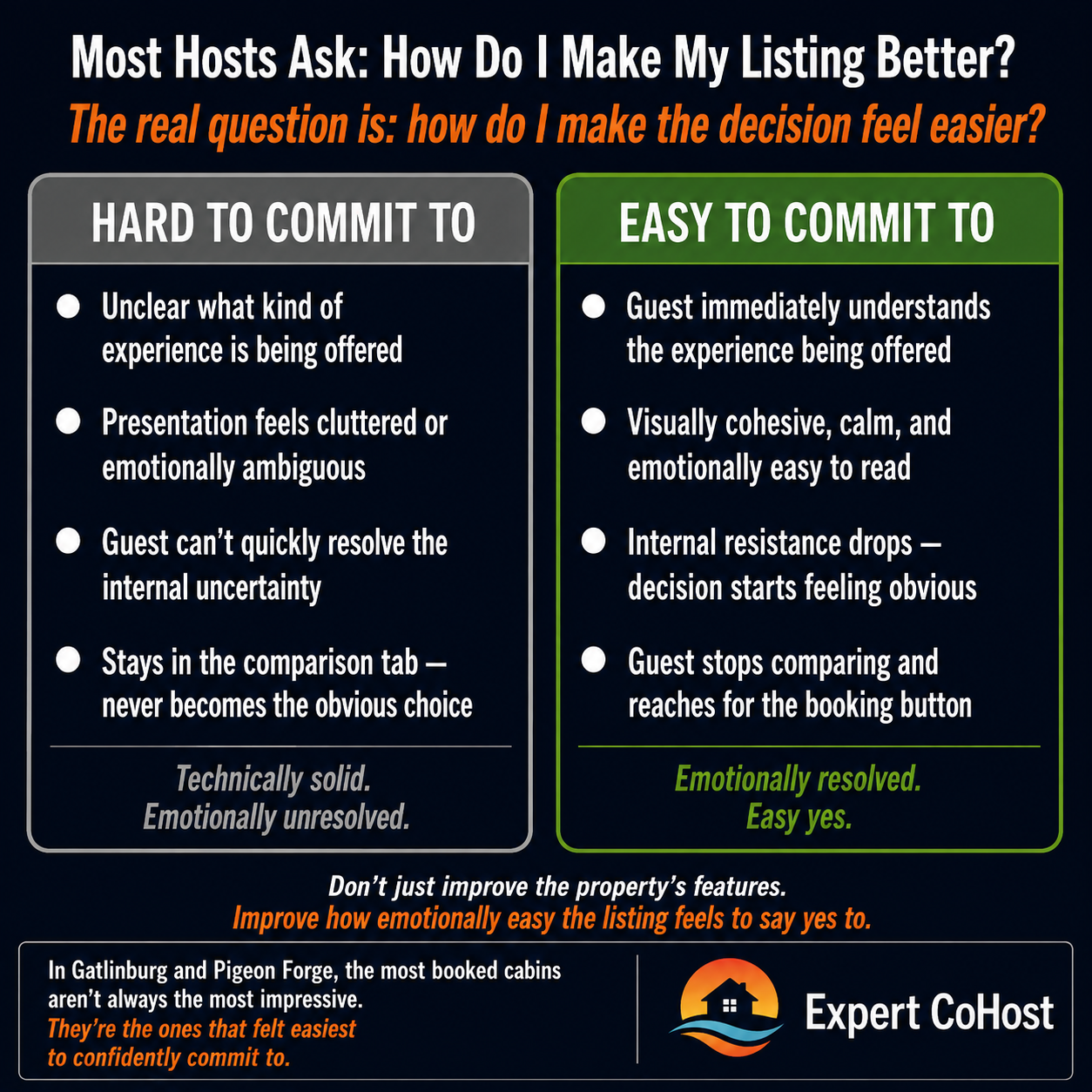
Some Airbnb listings feel surprisingly easy to book.
Guests open the page, browse briefly, and quickly feel:
“This feels right.”
Other listings may offer:
- similar pricing
- comparable amenities
- strong locations
- attractive photos
Yet still struggle to create the same booking momentum.
Why?
Because booking decisions are not driven by features alone.
They’re heavily influenced by how emotionally easy the listing feels to commit to.
Guests Want the Decision to Feel Resolved
Most guests do not enjoy prolonged comparison shopping.
Browsing dozens of listings creates:
- decision fatigue
- uncertainty
- emotional friction
- fear of choosing incorrectly
Which means guests naturally gravitate toward listings that reduce internal hesitation quickly.
Some listings create emotional resolution faster.
The decision begins feeling simpler.
Safer.
More certain.
Emotional Clarity Accelerates Commitment
One of the biggest drivers of “bookability” is emotional clarity.
Guests quickly understand:
- what kind of experience is being offered
- who the stay is for
- how the property will likely feel during the trip
That clarity reduces mental resistance.
The listing feels emotionally coherent instead of mentally demanding.
And when guests no longer need to work hard to interpret the experience, commitment becomes easier.
Trust Reduces Booking Friction
Guests are constantly evaluating emotional risk while browsing.
Even subconsciously.
They wonder:
- “Will this disappoint me?”
- “Will the stay feel like the photos?”
- “Will this trip feel worth the money?”
Listings that quietly reduce those fears feel dramatically easier to book.
Trust-building signals like:
- visual consistency
- organized presentation
- emotionally stable communication
- realistic expectations
- thoughtful positioning
all contribute to booking confidence.
Some Listings Create Immediate Momentum
Certain listings create emotional momentum almost instantly.
Guests begin imagining:
- waking up there
- spending time inside the space
- relaxing during the trip
- enjoying the atmosphere emotionally
Once that imagination starts, the guest stops evaluating the listing purely analytically.
The experience begins feeling personally relevant.
And emotionally relevant experiences feel easier to commit to.
Confusing Listings Create Hesitation
Many listings unintentionally create psychological resistance.
Examples include:
- inconsistent visuals
- cluttered presentation
- vague positioning
- emotionally unclear descriptions
- too much competing information
Guests may not consciously identify the issue.
But internally, uncertainty increases.
And uncertainty slows booking momentum quickly.
Ease Creates Perceived Confidence
Guests often mistake emotional ease for certainty.
When a listing feels:
- easy to understand
- emotionally aligned
- visually cohesive
- low-friction mentally
the booking itself begins feeling more correct.
That emotional confidence strongly influences conversion.
Because people naturally move toward decisions that feel psychologically lighter.
Bookability Is Emotional, Not Just Functional
Many hosts focus heavily on improving technical features.
And functionality absolutely matters.
But highly “bookable” listings often succeed because the emotional experience of browsing feels:
- smoother
- calmer
- safer
- more intuitive
The guest experiences less internal resistance while imagining the stay.
That emotional smoothness matters enormously.
The Real Shift
Most hosts ask:
“How do I make my listing better?”
But many booking decisions are shaped by a different question entirely:
“How do I make the decision feel easier?”
Because in a crowded short-term rental market, the listings that convert best are not always the most impressive.
They’re often the ones that feel emotionally easiest to confidently book.